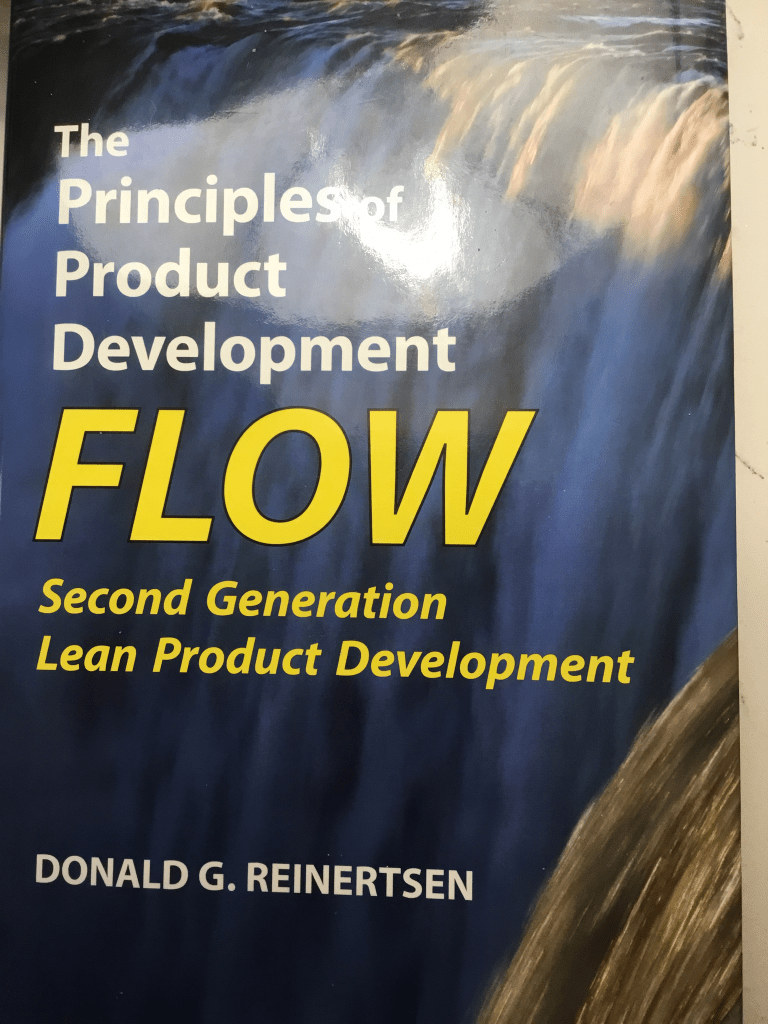
Principles of Product Development Flow by Donald Reinertsen
Why a book review when we have a wealth of information on the SAFE website freely available? I hope to answer that in the following paragraphs.
The Principles of Product Development Flow by Donald G. Reinertsen has often been described as a difficult read, I would describe it as a book that you can access to your level of interest. A statement of fact is presented that is easily accessible and you could stop there with an understanding of how that point is applicable. The topic is then expanded on with the mathematical formulas and graphs presented for anyone interested in the underlaying proofs. Since I have enough skepticism to read the proofs they provide me a little extra challenge and “fun”.
Chapter 1 describes the problem of Product Development process and a proposed solution that will sound familiar to anyone that has taken a SAFe course – especially Leading SAFe with the exploration of all 10 SAFe principles. With the understanding that large scale solution development is more like traditional product development than manufacturing one can observe the insights and gain a deeper understanding of the SAFe Principles as well as the SAFe House of Lean.
The problem statement observes that product development is often focused on capacity utilization and other proxy metrics that have been misapplied from Lean Manufacturing to the processes of Product Development. The problem is elaborated in the terms we would use as anti-patterns for the many of the SAFe Principles such as: Non economic decision making, long queues, inflexibility, early decision making, lack of WIP constraints, etc.
The proposed possible solution is immediately recognizable as a starter list of the SAFe Principles that is detailed in the following chapters The components of the solution are: Economics, Queues, Variability, Batch Size, WIP Constraints, Cadence – Synchronization – Flow. Control, Fast Feedback, Decentralized Decision Making.
The interesting facet of reading this is to equate the discussion of Product Development processes to the development of software solutions. Most are easily mapped 1 to 1, however there are other examples that seem to apply to specific functions of the solution process. One example is the idea that Product Development is the creation of the “recipe” to be executed by the following product manufacturing process. Rather than disregard this as not applicable to software development, I would map the idea of recipe creation to the Continuous Exploration phase of the Continuous Delivery Pipeline since the goal of the other phases are to create the usable solution.
The summary of Chapter 1 clarifies that that goal of the book to explore the set of foundational principles identified in the proposed solution. Then acknowledges that change of common managerial practices and mindsets take time and by acting now there is significant profit to be made while the rest of the world is catching up. Since this was written in 2009 and we are now 11 years on and the adoption of these principles for large scale solution development are just now being more widely adopted he worlds were prescient.
Now onto Chapter 2 – The Economic View
The first principle explored is the focused on the economics at the heart of Product Development. The initial paragraph refocuses the mind on the one and only reason for Product Development to exist, the goal of maximizing profits for the organization. It is this economic reality that should frame all other understanding of the following discussions rather than the proxy metrics that will naturally become part of the implementation of a new operating model. As in Chapter 1 there is an admonition to practitioners to avoid getting lost in the execution of the many sub-principles that follow.
The high level principle of “The Economic View” is described into 21 sub-principles that elaborate different facets of the overall principle. E2: Interconnected Variables, E3: Quantify the Cost of Delay, E6: U-curve Principle, E10: First Perishability Principle and E17: Ignore Sunk Costs are easily recognizable and are fully elaborated in the SAFe materials. That leaves 16 other very enlightening sub-principles that are also applicable to Solution Development in the SAFe Continuous Delivery Pipeline and serve to highlight the importance of the following principles.
An example of this is E7: The Imperfection Principle. Accepting this sub-principle has been a consistent challenge for most decision makers I have engaged with. The idea that even imperfect answers/information improve decision making is often rejected or delayed with the goal of waiting until more or better information is available. This sub-principle is a reason for the adoption of WSJF technique for job scheduling since it utilizes imperfect information in decision making. It is critical to understand that WSJF is only used in the absence of better information, as an organization develops better economic decision models they may find that WSJF can be replaced, however that should not delay the implementation of WSJF immediately.
I will pause here to avoid diluting the importance of the first 2 chapters. I will post additional insights that would be helpful in a deeper understanding of the SAFe Principles and the House of Lean in future blogs.
 Enterprise Agility